Live Demonstration
From Natural Speech to Coordinated Swarm Flight
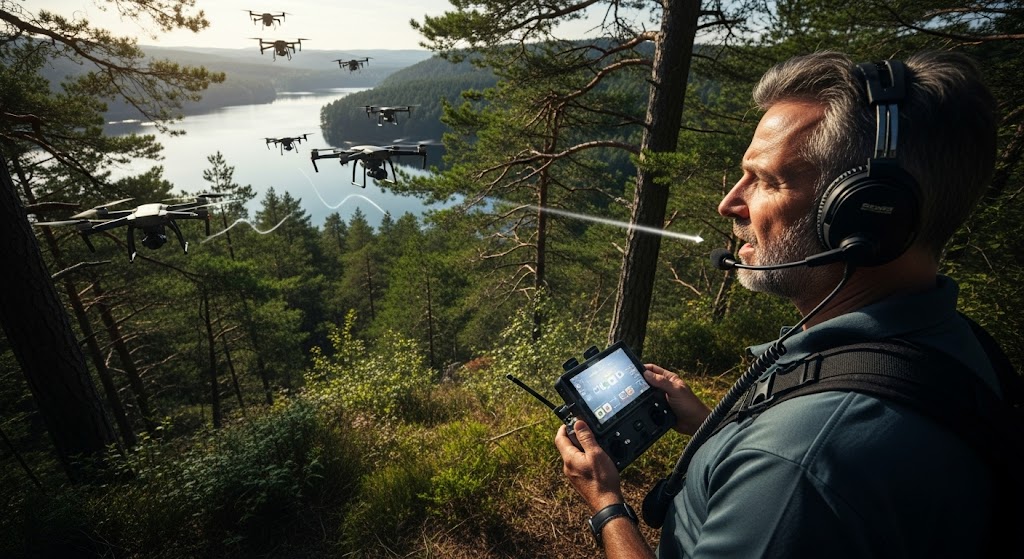
Live demonstration: chat interface and tool calls on the right, live map with the drones, their altitudes, and tool previews on the left.
Spoken Intent Translation
Hierarchical LLM multi-agent reasoning translates high-level tactical voice instructions into executable drone waypoints.
Closed-Loop Safety Gate
Every AI-generated mission passes state-machine verification and collision checks before any rotor spins.
Heterogeneous Air–Ground Teams
Seamlessly couples high-altitude UAV search patterns with ground rover (UGV) payload and victim rescue logistics.
Research Focus
Core Scientific Pillars
Human–Robot Teaming
Designing conversational interfaces that drastically reduce cognitive load in fast-evolving disaster and wilderness rescue missions.
LLM-MAS Planning & Dual RAG
Hierarchical multi-agent reasoning paired with Feature & State RAG memory for scalable coordination from 5 to 500 autonomous agents.
Field-Tested SAR Deployment
Full-scale experimental validation with emergency responders, thermal geolocation, and simulated wilderness search benchmarks.
Latest Breakthroughs
Verified Field Research
Swarm-Steward: Natural-Language Coordination of Large-Scale Robot Swarms
Autonomous coordination of up to 500 simulated drones and real-world 5-drone flight validation in Corfu, Greece.
Read research post → IEEE SSRR 2026One Operator, Many Robots: UAV–UGV Teams for Search, Victim Detection & Rescue
Voice-guided multi-UAV aerial search with real-time YOLO26 victim geolocation and ground rover deployment across 47,000+ m².
Read research post → IEEE SSRR 2025LLM-Enabled Voice-Commanded UGV for Logistics in Search & Rescue Missions
Real-world deployment with 150+ emergency responders delivering critical medical supplies and emergency batteries by voice.
Read research post →Research Team
Investigators & Collaborators

Prof. Anders Lyhne Christensen
Project PI · SDU
Multirobot systems, autonomous swarm coordination, and evolutionary robotics.

Assoc. Prof. Timothy Merritt
Co-PI · AAU
Human-drone interaction, conversational AI interfaces, and human-AI teaming.

Alejandro Jarabo Peñas
Lead Researcher · SDU
LLM multi-agent system architecture, natural language planning, and field robotics.
Assoc. Prof. Nathan Lau
Collaborator · Virginia Tech
Human factors engineering, ecological interfaces, and situational awareness.
Prof. Satoshi Tadokoro
Advisor · Tohoku University
World-renowned pioneer in disaster robotics and search & rescue field systems.

CEO Kenneth Geipel
Industry Partner · Robotto
Autonomous UAV solutions for search & rescue, firefighting, and environmental monitoring.