Swarm-Steward: commanding a robot swarm with natural language



What if commanding a robot swarm were as simple as describing the mission in natural language — instantly translating your spoken intent into a safe, coordinated mission? That's exactly what we demonstrated at IEEE ICUAS 2026 in Corfu, Greece, with our latest paper: Swarm-Steward: Scalable and Reliable Natural-Language Coordination of Autonomous Aerial and Ground Robots.
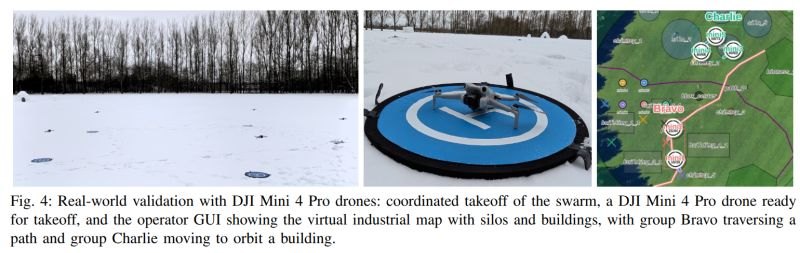
From running chilly winter field experiments in snowy Denmark to presenting under the summer sun in Corfu, this work is the NAMUR project's most complete demonstration yet of LLM-driven multirobot control.
Beyond a "chat with robots" demo
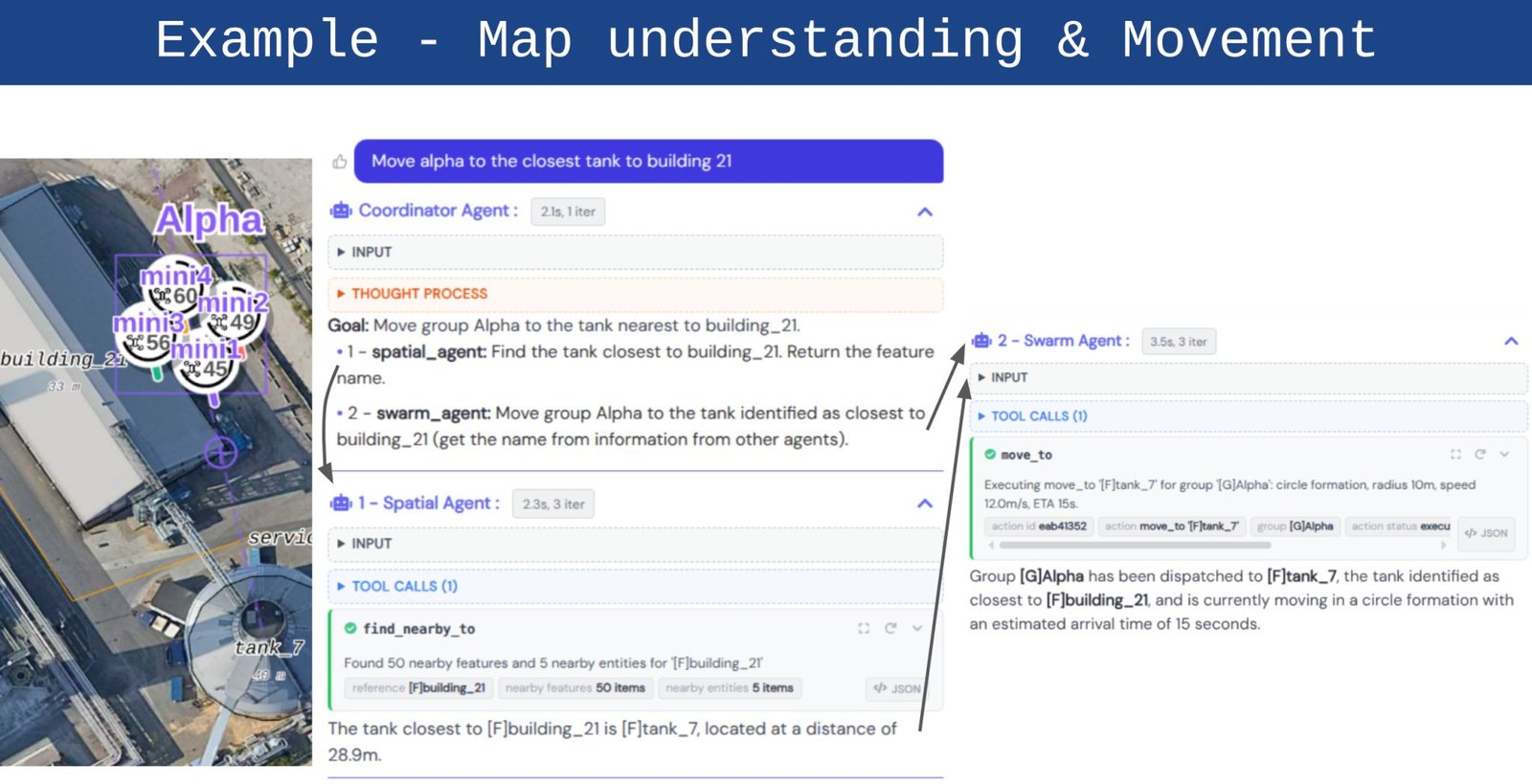
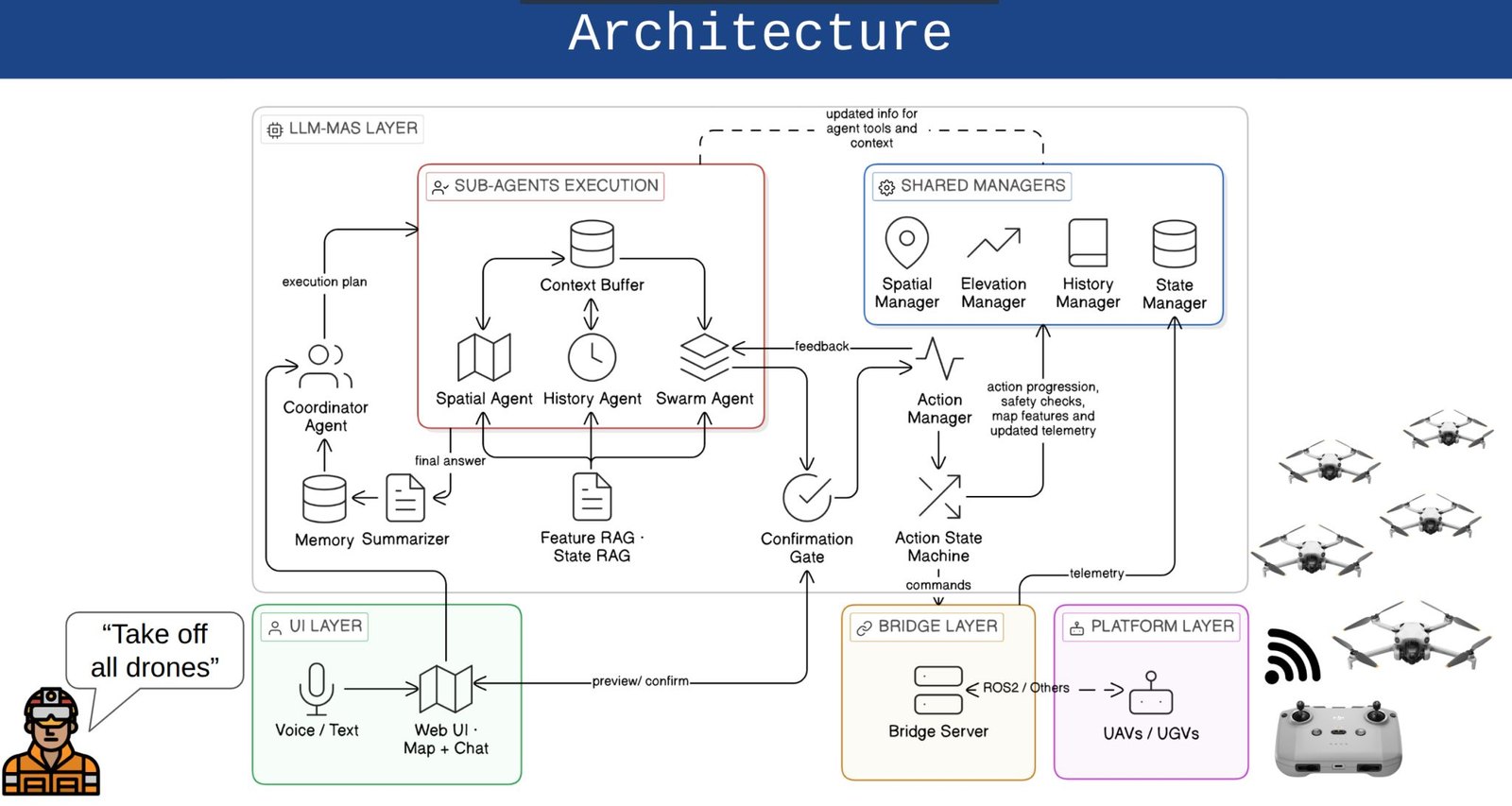
Swarm-Steward is a platform-agnostic system that coordinates autonomous aerial and ground vehicles through everyday speech. Instead of writing complex code, an operator simply expresses their high-level intent, and the framework translates it into structured, safe, and executable multi-agent behavior. We built it for real-world reliability:
- Hierarchical LLM architecture — strictly separating planning, grounding, and execution.
- Targeted RAG pipelines — retrieving dynamic map features and telemetry on the fly.
- Action execution & guardrails — the LLM agents only choose what to do based on intent, while actual execution and safety are always handled by deterministic algorithms.
Does it scale?
We tackled the most critical practical question — and the numbers speak for themselves:
- 📈 Near-constant LLM token cost when scaling from 5 to 500 drones.
- 🎯 92.9% task success rate across 280 distinct prompts.
- 🔄 Flawless sim-to-real transfer on a physical 5× DJI Mini 4 Pro swarm using identical mission logic.
Ultimately, this is a step toward making autonomous systems accessible to non-experts without sacrificing the robustness and auditability required for field deployment.
Swarm-Steward: Scalable and Reliable Natural-Language Coordination of Autonomous Aerial and Ground Robots
Jarabo-Peñas, Bravo-Arrabal, Rolland, Christensen · IEEE ICUAS 2026, pp. 796–804
IEEE Xplore · DOI · ResearchGate · Watch the system in action (video)
Supported by the Independent Research Fund Denmark (grant 10.46540/4264-00105B, NAMUR project), Innovation Fund Denmark through DIREC (PERSIST, U07), and the EU Horizon Europe WildDrone project (Marie Skłodowska-Curie grant 101071224).