The NAMUR project: natural-language control of multi-drone teams
This site is named after it, so it deserves the first post: NAMUR — Natural-language Assisted Human-Multirobot Interaction and Planning — is the project that started it all. Funded by the Independent Research Fund Denmark (DFF Project 2) for four years (November 2024 – October 2028), NAMUR is led by SDU’s UAS Center with Aalborg University sharing the funding equally, hiring a PhD student at SDU (multirobot planning and control) and a postdoc at AAU (LLM-enabled user interfaces), with collaboration from Virginia Tech, Tohoku University and Robotto.
💬 The vision
Today, operating a team of drones means manually piloting each unit or learning intricate, specialised planning software. NAMUR’s vision: make mission specification as easy as talking. Imagine a first responder who has deployed drones to search a marsh for a missing person and, mid-mission, new information arrives — they simply say:
“Please reprioritize and focus on the north tree line close to the lake, fly low and scan under the canopy.”
A new mission template is generated automatically, shown with UI elements (sliders, modifiable regions) to adjust the trade-offs, and refined until the specification matches the operator’s intent. The hypothesis: combining an LLM — flexible, full of common-sense knowledge — with precise, logic-based multirobot planning algorithms lets an operator specify and adapt missions significantly faster and with fewer mistakes than without the integration.
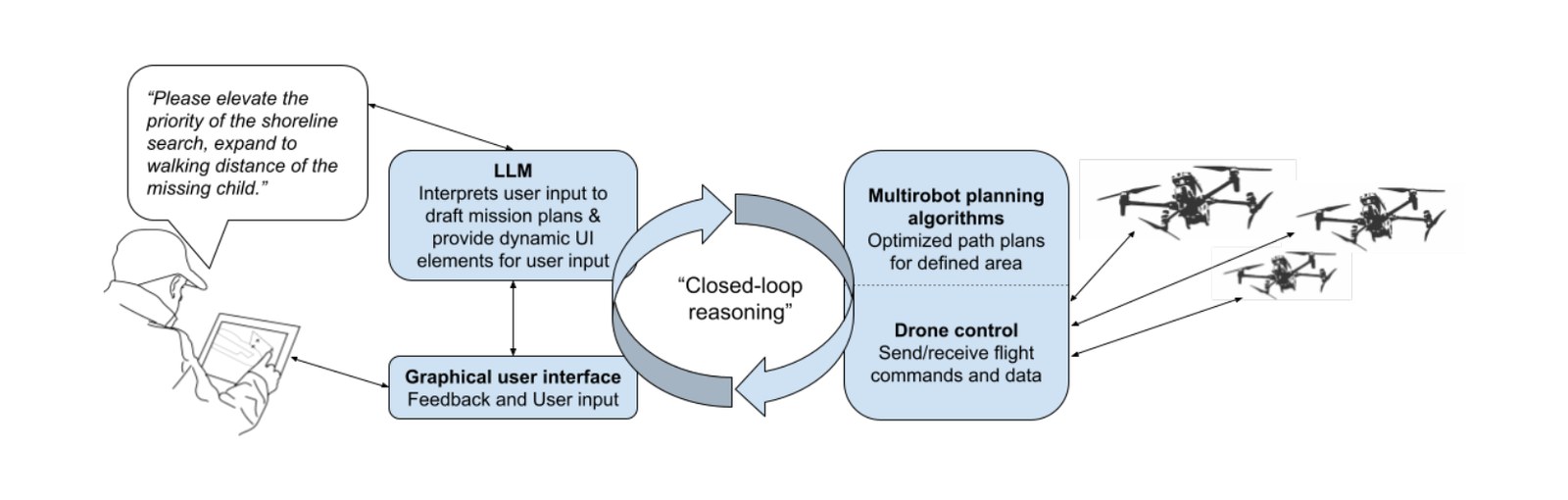
Figure 1 — NAMUR concept: natural-language instructions are interpreted by an LLM that drafts mission plans in a high-level domain language; the operator refines them through the GUI while multirobot planning algorithms compute feasibility, performance and safety, closing the loop with the physical fleet.
🧠 Three research challenges
The project focuses on three challenges: (i) integrating logic-based multirobot planning with LLMs in closed-loop reasoning for efficient plan generation; (ii) exploring user interfaces that enable both low-level and natural-language definition, refinement and adaptation of multi-UAV missions; and (iii) establishing situational awareness, error-handling and feedback so the system adapts to changes in the operational environment. The KPIs are concrete — plan correctness of 80/90/95% after 1/2/3 LLM–planner iterations, a 60% reduction in mission specification time, a 40% reduction in situational-assessment time, and a TRL5 demonstration on physical UAVs.
🌍 The NAMUR benchmark
To evaluate the system, the project builds the NAMUR benchmark dataset: diverse environments where multi-UAV SAR operations are relevant — marsh, coastline, fjord, heathland, urban and mountain — with 25 areas per environment type (10–100 km²) selected together with Robotto and their end-users, and key environmental features extracted from OpenStreetMap. Search plans are evaluated against the SAR organisations’ operating guidelines, targeting a probability of detection (POD) of up to 80%.
👾 The team
- Prof. Anders Lyhne Christensen (PI) — SDU UAS Center — multirobot systems and planning
- Assoc. Prof. Timothy Merritt (Co-PI) — AAU Human-Centered Computing — human–drone interaction
- Assoc. Prof. Nathan Lau — Virginia Tech — ecological interface design for UAS operations
- Prof. Satoshi Tadokoro — Tohoku University — advisor, SAR and disaster robotics (25+ years)
- Kenneth Geipel (CEO) — Robotto — end-user involvement and industry deployment
And it is already producing results: Swarm-Steward — the natural-language multi-robot coordination system showcased in our ICUAS 2026 paper and on this site — is the first system to come out of NAMUR, and the PERSIST project builds directly on it.